08 September 2026
Wooden Wine Crates: What to Specify Before You Order
Wooden wine crates are not all the same. One kind is the used shipping crate you find in a barn, kept for looks. We do not sell those. This page is about a custom wine crate made to your bottle, your label, and your shelf. It covers bottle count, internal fit, construction, surface finish, storage stacking, and the files to send for a quote.
Start With the Crate You Actually Need
A used wooden wine crate is a different thing from a custom wine crate made to order. The first is often a retired shipping box, sanded down and kept as a shelf piece. We do not sell those. The second is one of the wooden bottle crates we build around your bottle, your label, and your gifting or retail plan. If you are comparing options, our Solid Wood Wine Boxes show the two solid-wood styles we build, and our Custom Wooden Wine Box Manufacturing page explains how the spec becomes a sample and then a finished crate.
If you are comparing wine crates for sale, the question is not which crate looks nice. It is which crate survives your shelf, your courier, and your end user. A crate can look strong and still fail when a full bottle shifts, when a corner splits, or when a printed surface scratches. This article walks through the decisions that matter before you order, so the crate matches the job.
Bottle Count and Layout
Start with bottle count. Two, three, six, or a single display bottle? The count fixes internal length and depth. Then measure the bottle that will actually ship, not the nominal volume. The numbers that matter are shoulder diameter and total height including the capsule. A 750 ml bottle with a long neck is not the same as a 750 ml bottle with a short neck. If you send us a bottle sample or exact dimensions, we can set the inner box size so the bottle sits level, not loose.
Also decide the layout. Bottles in a row, in a grid, or around a central label? The layout changes the wall positions, the number of dividers, and the way the crate is picked up. If the crate will be stacked, the base must be flat and the top must carry the load. For retail display, the visible face and the way the crate opens are part of the layout, not an afterthought.
Internal Fit and Inserts
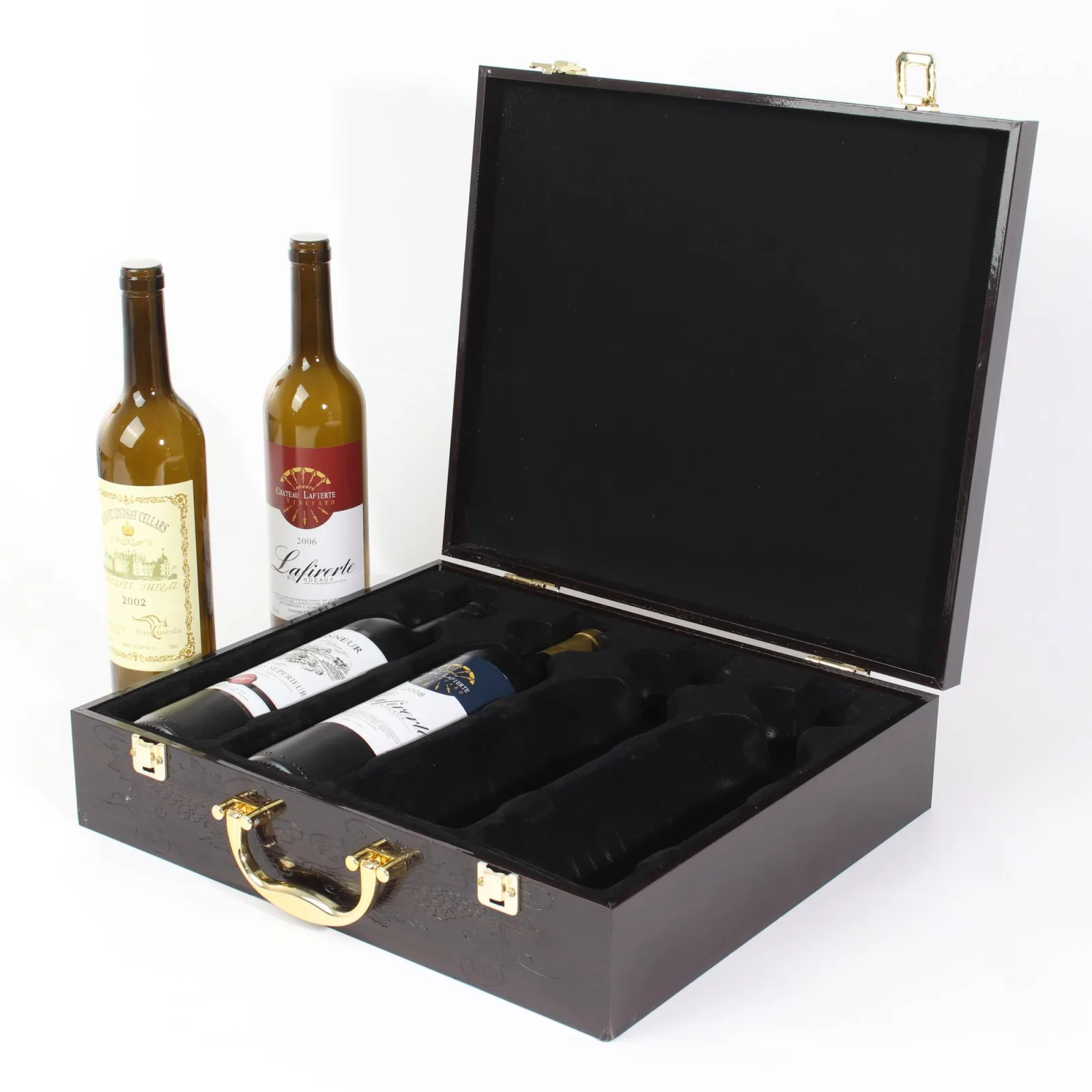
Our insert rule is simple. The bottle is held at four points, with no unsupported neck or shoulder. That keeps the glass from rocking, scraping, or pressing against the wood. For a wine crate, the insert is not just padding. It sets how the bottle sits, how the crate moves in a truck, and how the buyer perceives value. A loose bottle in a wooden crate is one of the most common failures we see.
Choose the insert by function. A velvet tray gives a soft, premium feel and suits collector gifting. EVA foam gives firm support for shipping. Blister trays can be custom moulded to the bottle and help with retail presentation. Paper mould, or moulded pulp, is the light and practical choice for volume. Our in-house checks include shaking for 10 seconds with no movement, tilting 45 degrees with no slide, and inverting with no release. If you want more on lids, see Wine Crates with Lids: What to Specify.
Construction and Surface Finish
Construction is where wooden crates live or die. Look at wall thickness, corner joints, and how the crate behaves when picked up full. Thin walls flex. Weak joints split at the corner. A crate that feels light and hollow will not protect a bottle in freight. For Materials and structures, the wood, the joint, and the finish each decide how the crate moves, holds, and looks on your shelf.
Surface and branding come next. Engraving gives a clean mark. Screen print can carry more colour, but wood grain changes how the ink sits. Lacquer protects the surface and gives it sheen, but it can also chip if the crate is handled roughly. Decide what the customer will see first. If the crate is a gift, the finish is part of the unboxing. If it is wholesale, the surface must survive stacking, not just the first glance.
When Wood Is Not the Right Answer
Be honest about when wood is the wrong answer. It costs more than board. It weighs more in freight. It moves with humidity. For wine crates wholesale, a rigid board box with a wood grain facing paper gets most of the look. That is what our Faux Wood Wine Boxes are for. If your buyer will store or display a crate, wood can be the right choice; if your buyer will ship or stock it, compare the weight, the cost, and the stability before committing to solid wood.
A rigid board crate can look like wood and still be lighter, flatter, and easier to stock. We use greyboard with a 157 g facing paper for many of these boxes. For spirits, our board standard is 1200 g greyboard minimum and 1400 g recommended, with 157 g facing paper. For wine, the same board standard applies to the box body. The buyer should choose by use case, not by the word wood.
Storage, Stacking, and What to Send
Many buyers want wine crate storage on a shelf, not just a gift box. That means the crate must stack cleanly. Our in-house pre-shipment checks include a 1.2 m six-face drop test with the bottle loaded, a stacking top load of 40 kg or more for 24 hours, and truck and sea vibration simulation with no internal movement. For retail storage, the crate should keep its shape, its corners, and its label face. If a crate is going to sit in a warehouse, the base and the lid or top must carry the load without bowing.
To start a quote, send us the crate dimensions or a bottle sample, a reference design, and any special requirements. We can make two sample types: a blank sample that proves the structure, and a printed sample that proves the visual. You can also ask for engraving, screen print, or lacquer. If you are comparing options, our Custom Wooden Wine Box Manufacturing page walks through the process from design confirmation to quality inspection and packing.
- Send a bottle sample or exact dimensions.
- Send a reference design if you have one.
- List special requirements such as engraving, print, or lacquer.
Key points
- Start with bottle count and layout, because they fix the crate size.
- Use four-point support and a 45 degree tilt check before shipping.
- Choose wood only when storage, gifting, or display needs justify it.
- Send dimensions or a bottle sample, a design, and special requirements.
Questions buyers ask
How many bottles can a wooden wine crate hold?
That depends on your bottle and layout. A two-bottle crate is compact and easy to gift. A three or six bottle crate is for larger collections or retail display. Start with shoulder diameter and total height including the capsule, then decide row or grid layout. We can make a blank sample first, then a printed sample, so you see the structure and the finish before full production.
Do you sell used shipping crates?
We do not sell used wooden crates. Our range is custom wine crates made to your specification. For the site, we carry two solid-wood styles, one faux-wood box, and a range of rigid board boxes, leather boxes, and bags. If you want a decorative used crate, that is a separate product. If you want a crate that protects bottles, we build it to your bottle, label, and shelf use.
When should I choose wood over board?
Choose wood when the crate is for storage, collector gifting, or retail display. Choose a rigid board box with wood grain facing paper when you need lower weight, easier stacking, or volume retail. Solid wood costs more and moves with humidity. For shipping, compare wall thickness, corner joints, and stacking load. For a full crate, the base and top must carry the load without bowing.
Send us your bottle dimensions or sample, a reference design, and special requirements to start a custom wine crate quote. Get a Quote
Put this on your bottle
Send the bottle sample or dimensions, quantity and a reference design. We reply with structure options and pricing.
- Email[email protected]