23 September 2026
Wooden Wine Box Manufacturers: How to Choose One
No two wooden wine box manufacturers build the same thing, so compare what each one actually makes. Ask which structures they offer, which board they run, how they hold the bottle, and what they check before the box ships. That conversation tells you more than any sample photo.
Start With the Range, Not the Price
Solid wood boxes and crates are the traditional pick. You get weight, grain and a lid that sounds like something when it closes. That weight is also the problem: a solid crate adds real kilos to a parcel, and a winery shipping single bottles feels it. Faux wood gives the look on a different substrate, so it's lighter and cheaper to move, but it isn't wood and won't behave like wood under a stack.
Then there's everything else. Rigid board, leather and bags cover buyers who never needed solid wood in the first place. A collector-gifting buyer wants the lid to feel substantial. A retail-display buyer wants the box to survive a shelf and a courier van that gets loaded three times before it reaches the customer. Those are different jobs, and the honest suppliers will tell you which one their box is built for.
- Solid wood: weight and grain, best for display and gifting where the box stays put.
- Faux wood: the look without the mass, so it ships lighter than a real crate.
- Rigid board: the workhorse for printed runs and repeat programs.
- Leather and bags: for buyers who want presentation without a box at all.
Ask Which Structures They Actually Build
The structure list is where a supplier's real capability shows. Rigid lid-and-base is the classic two-piece. Magnetic closure hides the magnet in the board and gives a soft snap. Drawer slides out sideways and suits a bottle lying down. Foldable ships flat and erects at the far end. Double-door opens from both sides for a presentation moment. Handles change how the box is carried and where the stress lands.
A manufacturer that only runs one or two of those is not lying to you, but they will steer every brief toward what they have. If your retail-display buyer needs a foldable box for export, a supplier whose whole line is rigid lid-and-base will quote you the rigid box and you'll pay to ship air. Check the range before you send artwork. Our own materials and structures page lists what we run, and it's fine to compare it against what you're being offered elsewhere.
Board Standard for Rigid Boxes
If the box is rigid board, the board is the box. Our standard is greyboard 1200 g minimum, and 1400 g recommended for spirits. Spirits bottles are heavy and the board has to hold the shape without bowing at the shoulder. Facing paper is 157 g minimum, specialty or coated, because thin facing shows every ripple over a greyboard edge.
Two things we won't run: recycled greyboard and high-moisture paper. Recycled board varies batch to batch, so the box that looked right in the sample comes back wavy. High-moisture paper shrinks as it dries and pulls the corners out of square. Neither shows up in a photo. Both show up on a shelf. A wooden wine crate manufacturer working in solid timber has a different set of rules, but if the quote is for rigid board, ask the board weight directly and listen for a number.
Insert Fit Is Where Boxes Fail
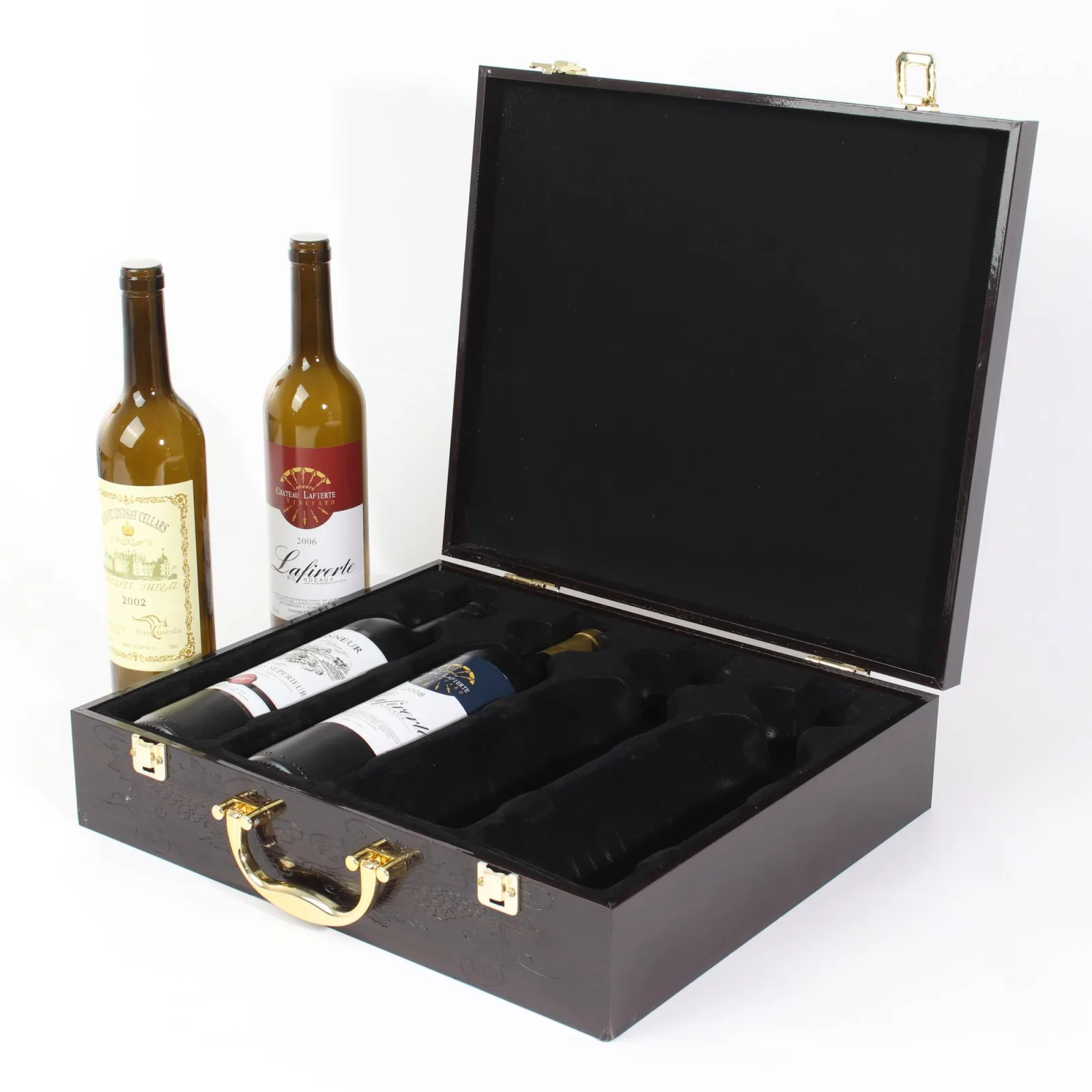
Most complaints trace back to the insert, not the print. The rule is simple: the bottle is held at four points, and there is no unsupported neck or shoulder. If the neck floats, the bottle rocks. If the shoulder is unsupported, the weight sits on the base and the box flexes in transit. Four points means the base, the body and both sides of the shoulder share the load.
We check it three ways. Shake for 10 seconds, no movement. Tilt to 45 degrees, no slide. Invert, no release. A box that passes all three holds the bottle the way a hand would. A box that passes the shake but fails the invert will drop a bottle onto a customer's floor. Inserts come as velvet tray, EVA foam, blister or paper mould, and the choice changes the fit, so settle the insert before you approve the print.
Control Tolerances Tell You Who Is Careful
Tolerances are the quiet part of the quote. Our control tolerance on the insert is plus or minus 1 mm, and plus or minus 2 mm on the box body. That's the window where the bottle still sits right and the lid still closes clean. On foldable boxes, creases must not crack, magnet position is plus or minus 1 mm, and corners are square when erected. A box that arrives out of square looks wrong on a shelf and nobody can say why.
Colour is the other half. We match Pantone, approve a first article, then sample mid-run. Black, deep blue and burgundy are the hardest to hold, so expect the closest attention there. If a supplier can't tell you what they do when the second half of a run drifts, that's your answer. Our quality control process is written out if you want to compare it line by line with someone else's.
What Gets Checked Before the Box Ships
Our in-house checks run before anything leaves. A 1.2 m six-face drop test with the bottle loaded, so the box takes the hit the way a parcel does. Stacking top load of 40 kg or more for 24 hours, which is what a pallet does to the bottom box. Truck and sea vibration simulation, and afterwards there should be no internal movement. If the bottle has shifted inside the insert, the insert failed, not the box.
These checks are ours, not a standard we bought. They exist because we've seen what happens without them. A box that passes a drop test on a corner and fails on a face is a box that needed a better insert. Ask any supplier what they run and when they run it. The answer is usually shorter than the question.
The Eight Steps, and Where Buyers Lose Time
The build runs through eight steps: online consultation, design confirmation, plate making and proofing, machine printing, machine lamination, machine box making, hand assembly, quality inspection and packing. Hand assembly is where the insert goes in and where most of the fit is decided. It's also the step buyers forget when they plan a schedule.
The step that saves the most rework is design confirmation. Send the bottle or the exact dimensions, the reference design, the quantity and any special requirements, and get the structure agreed before plates are made. Changing a structure after proofing means new plates and a new proof. That's not a price lecture, it's just the order things have to happen in. Our custom wooden wine box process walks through it from the first message.
When Our Product Is the Wrong Answer
Plenty of briefs shouldn't land on a wooden box. If you need a solid wood crate for heavy stacking, a faux wood box won't satisfy you, and neither will rigid board. Go to a wooden wine crate manufacturer who builds in timber and accept the freight. If you need a foldable box for export, a rigid lid-and-base will cost more to ship than the box is worth. Buy the foldable.
And if the box is a mailer that gets thrown away, don't buy leather. A leather box is a gift object. It's the wrong spend for a shipping carton. The right move is to say what the box has to survive, then pick the structure that survives it. Browse the full range of boxes and alternatives and you'll see the trade-offs laid out side by side. If solid wood is genuinely what you need, we'll say so.
What to Send Us
Send box dimensions or a bottle sample, a reference design, the quantity and any special requirements. That's enough to talk structure. A bottle sample beats a drawing every time, because the shoulder shape decides the insert and the insert decides whether the box works.
Two sample types are available: a blank sample to check the structure, and a printed sample to check the visual. Start with the blank if the fit is in question. Bring the bottle, we'll hold it at four points and shake it.
Key points
- Compare structures first: rigid lid-and-base, magnetic, drawer, foldable, double-door, handles.
- For rigid board, greyboard 1200 g minimum, 1400 g for spirits, facing paper 157 g minimum.
- The bottle needs four support points, no unsupported neck or shoulder.
- Control tolerance: insert plus or minus 1 mm, box body plus or minus 2 mm.
- Pre-shipment: 1.2 m six-face drop, 40 kg stack for 24 hours, vibration simulation.
Questions buyers ask
What should I check first when comparing wooden wine box manufacturers?
The structure list and the board weight. Ask which structures they actually build and what greyboard they run. A supplier who only makes rigid lid-and-base will quote you that box even when a foldable would ship better. Board and structure decide everything downstream, including whether the insert can hold the bottle.
How do I know the insert will hold my bottle?
Ask for the four-point rule: base, body and both sides of the shoulder supported, with no unsupported neck or shoulder. Then ask how they test it. A 10 second shake, a 45 degree tilt and an inversion tell you more than any photo. If the bottle moves on inversion, the insert failed.
Is a faux wood box as good as solid wood?
It depends on the job. Faux wood gives the look on a lighter substrate, so it ships cheaper and prints well. It won't carry the weight or the grain of real timber, and it won't take heavy stacking. If you need a solid crate for stacking, buy solid wood. If you need the look in a parcel, faux wood is the better spend.
Send your box dimensions or a bottle sample, a reference design, quantity and any special requirements, and we'll come back on structure. Get a Quote
Put this on your bottle
Send the bottle sample or dimensions, quantity and a reference design. We reply with structure options and pricing.
- Email[email protected]